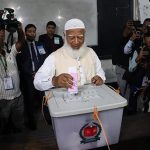

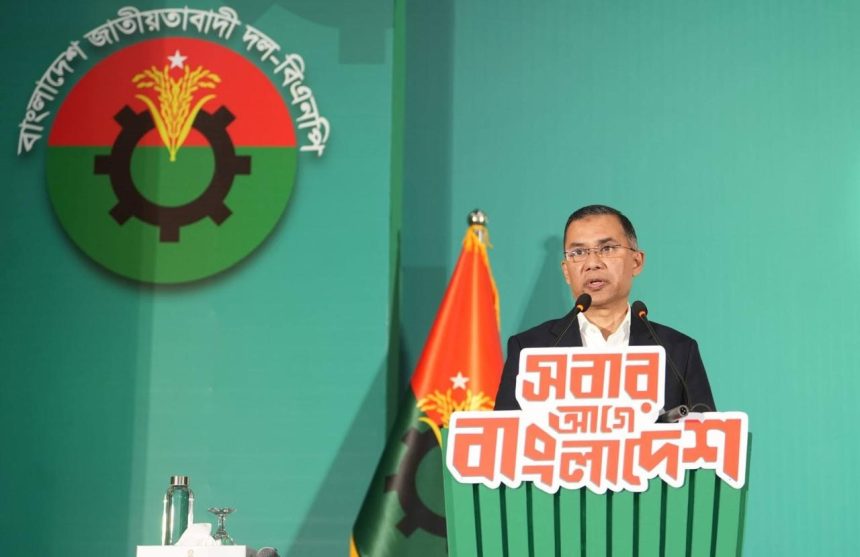
Dhaka – The Bangladesh Nationalist Party (BNP) has swept victory in the country’s general election, with the party achieving an overwhelming parliamentary majority to form government for the first time in two decades.
The party led by late former prime minister Khaleda Zia, along with its right-wing alliance partners, was in power last time between 2001 and 2026 before a military backed government took over amid political turmoil.
Tarique Rahman, son of Khaleda Zia, who returned home in only December after 17 years of exile is now leading the party and likely to be the next prime minister of the country. He became party chief in January following the passing of his mother on December 30.
Election officials confirmed on Friday that the BNP alone secured more than 200 seats in parliament in Thursday’s election.
Akhter Ahmed, Senior Secretary of Election Commission, at a news briefing said the party own in 209 out of 297 parliamentary constituencies, result of which was made public.
Result of two constituencies in south-eastern Chattogram remained withhold because of a court order, and election in another northeastern constituency of Sherpur was postponed after a contender was died of illness during the electioneering, he said.
Bangladesh Jamaat-e-Islami, the largest Islamic party and once alliance partner of the BNP, bagged 68 seats, according to the election official.
National Citizen Party, a political group formed by the students who spearheaded an uprising one and a half years ago, won in six parliamentary seats while Bangladesh Khelafat Majlish, a radical Islamic group, won in 2 seats, according to the election official.
One each seat was owned by Islami Andolon Bangladesh, Gono Odhikar Forum, Bangladesh Jatiyo Party, Gano Snaghati Andolon and Khelafat Majlish. Seven independent contenders came out successfully, said the commission official
He said the voters’ turnout in Thursday’s election was 59.44.
Initial projections based on polling station results has showed the BNP and its allies on course for more than a two-thirds majority in parliament.
“Voters have mandated our party to serve the nation for the next five years,” Nazrul Islam Khan, chief election coordinator of BNP, told reporters in Dhaka.
The vote was largely peaceful and marked the first national election since a student-led uprising ousted former prime minister Sheikh Hasina’s government in 2024, ending her 15-year rule.
A referendum on constitutional reforms prompted by the unrest was held alongside the parliamentary ballot under an interim administration led by Nobel Peace Prize laureate Muhammad Yunus, who took office after the uprising.
Over 48 million voters voted in favour of constitutional reforms while more than 22 million voters opposed.
Bangladesh’s 350-seat parliament includes 50 seats reserved for women. Voters directly elect 300 lawmakers, and at least 151 seats are required to form a government. Members of the reserved seats are chosen from among the parties representing parliament based on their proportionate seats secured in the direct election.
Chief Election Commissioner AMM Nasir Uddin described Thursday’s vote as one of the best in the country’s history, in a nation often plagued by political unrest.
He said that he kept the promise of holding a neutral election.
Meanwhile, BNP chief Tarique Rahman, urged party supporters to refrain from staging victory processions following the projected win.
Global leaders congratulate Rahman for his election victory.
In a post on social media platform X, Indian Prime Minister Narendra Modi said: “This victory shows the trust of the people of Bangladesh in your leadership.”
“I look forward to working with you to strengthen our multifaceted relations and advance our common development goals,” he added.
Pakistani President Asif Ali Zardari also congratulated Rahman as well as the people of Bangladesh “on their successful, peaceful polls.”
“Pakistan reaffirms strong support for democratic partnership and shared progress ahead,” he said in a post on X.