


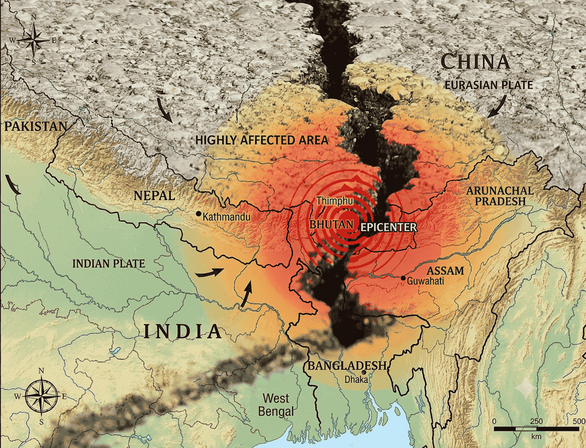
Dhaka – A moderate earthquake originating in neighboring Bhutan was felt across Bangladesh on Sunday night, triggering momentary panic among urban residents.
The tremor struck at approximately 11:36 pm and was strongly felt in the capital, Dhaka, as well as in other districts including Khulna, Gopalganj, Rajshahi, Dinajpur, and Rangpur.
There were no immediate reports of casualties or major structural damage in any part of the country.
The earthquake’s epicenter was located about 15 kilometers west-northwest of Punakha in Bhutan, a small Himalayan nation with a population of less than one million.
According to the United States Geological Survey (USGS) and local seismological centers, the epicenter was located near Punakha and the capital city of Thimphu at a shallow depth of 10 kilometers.
Strong tremors, which measured 5.6 on the Richter scale, was also felt across several neighboring regions, including parts of Nepal, India, and China.
Bangladesh is highly vulnerable to seismic disasters due to its unique geological position at the active convergent boundary of the Indian, Eurasian, and Burma tectonic plates.
The continuous collision and subduction of these massive plates build immense pressure within the Earth’s crust, frequently discharging as light to moderate tremors.
In recent years, the frequency of earthquakes has risen significantly, with Bangladesh experiencing many minor and moderate quakes.
On November 21, 2025, a magnitude 5.4 earthquake struck near Dhaka, followed by at least four aftershocks. At least ten people died, and nearly 630 others sustained injuries. It was the deadliest earthquake to strike the country in over two decades.
Compounding the tectonic risk is the country’s unique deltaic geography. The soft, river-saturated sedimentary soil prevalent in cities like Dhaka makes urban zones highly susceptible to liquefaction, a phenomenon in which shaking ground behaves like a dense liquid, causing building foundations to shift rapidly.
To counter this looming threat, strict enforcement of the Bangladesh National Building Code (BNBC) is mandatory for all new construction.
Experts emphasize that regular public evacuation drills, civil training, and structural retrofitting of older, densely packed buildings are vital steps needed to safeguard millions of lives when a major earthquake strikes.