

Dhaka – The government on Thursday unveiled an ambitious national budget outlining a total allocation of Tk 9,380 billion ($76.3 billion), focusing mainly on stability, investment, and production amid the risk of global economic uncertainty, particularly due to conflicts in the Middle East and the prolonged Russia-Ukraine war.
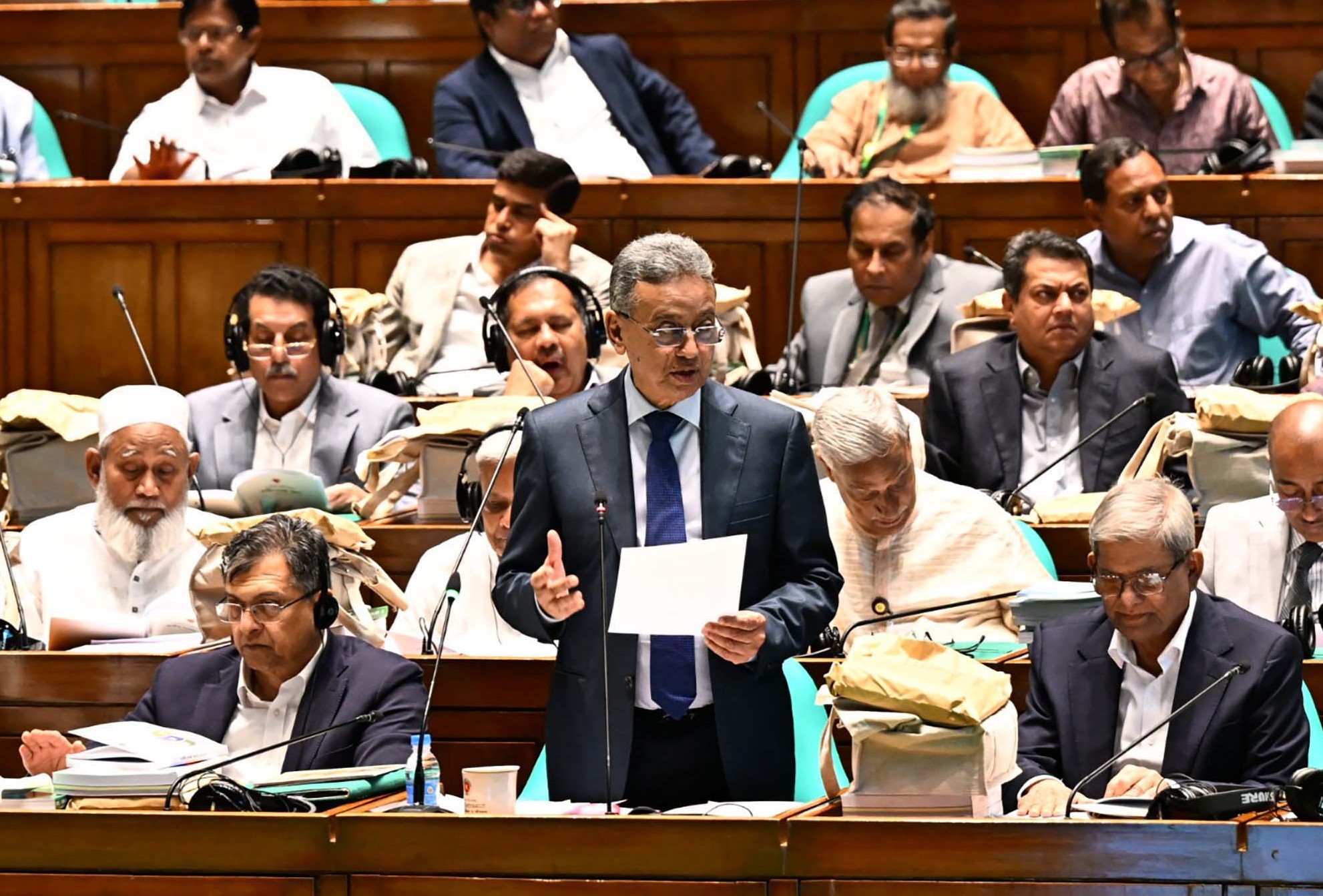
Finance Minister Amir Khosru Mahmud Chowdhury placed the budget in parliament in the afternoon, expressing hope that Bangladesh would become a trillion-dollar economy by 2034, provided that the plans and strategies his government has devised to overcome the fragile economy are implemented.
“Keeping at the center our determination to address the fragile state of the economy and the new risks created by global instability, we have designed this budget with stability, investment, production, employment and, above all, fairness as our guiding principles,” the minister said in his budget speech.
This is the first budget presented by an elected government since a mass uprising ousted former Prime Minister Sheikh Hasina’s Awami League government in 2024.
The Bangladesh Nationalist Party (BNP) of Prime Minister Tarique Rahman formed the government following its landslide victory in the February election, which was supervised by an interim administration headed by Nobel laureate Muhammad Yunus. Yunus had taken over in the aftermath of the uprising in August 2024.
The current government is placing the budget only four months after assuming office. It has inherited an economy that has been battered since the Covid-19 pandemic in 2020, the Russian war on Ukraine beginning in 2022, and the recent US-Israel strikes on Iran earlier this year.
In his budget speech, titled “Journey Towards a Democratic, Humane and Inclusive Economy,” the finance minister set a growth target of 6.5 percent, with a projection of gross domestic product (GDP) reaching nearly $556 billion.
He expressed hope that Bangladesh would become a trillion-dollar economy by 2034 through the implementation of the plans and strategies his government has laid out.
The government has earmarked more than $56.5 billion in revenue to finance public expenditure across various sectors.
It plans to borrow nearly $19.7 billion from external and domestic sources to meet the overall deficit, which is estimated at 3.7 percent of GDP.
Lawmakers will debate the allocations and are expected to pass the budget ahead of the new financial year, beginning on July 1.
The proposed budget, the largest in the country’s history, reflects the government’s commitment to economic recovery, investment promotion, human resource development, and improved public service delivery.
The government has set an inflation target of 7.5 percent.
In his budget speech, the minister highlighted the government’s priorities in education, healthcare, employment generation, private-sector-led investment, and social protection.
He reiterated the government’s pledge to build a knowledge-based economy and expand opportunities for the country’s growing youth population.
The budget speech also featured a series of deregulation and business facilitation measures, including simplification of licensing procedures, modernization of tax administration, and expansion of digital services to improve the ease of doing business and attract both local and foreign investment.