

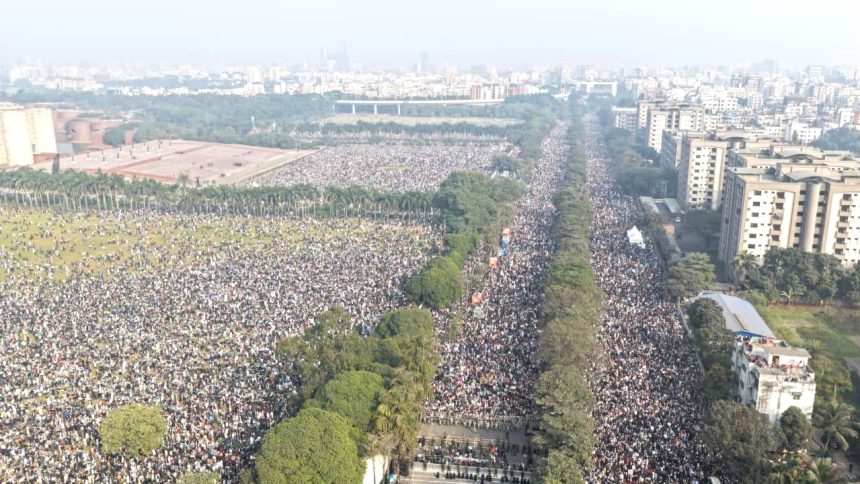
Dhaka – Hundreds of thousands of people bid farewell to Bangladesh’s former prime minister Khaleda Zia on Wednesday with tears, love, and respect at a state funeral held at the National Parliament’s south plaza.
The funeral prayer, led by Abdul Malek, the Khatib of Baitul Mukarram National Mosque, began around 3 pm amidst a sea of mourners, the very people for whose rights Khaleda Zia had fought, been arrested, and imprisoned.
Khaleda Zia, the chairperson of Bangladesh Nationalist Party (BNP) and the first female prime minister of the Muslim-majority nation, died on Tuesday morning at the age of 80 in Dhaka’s Evercare Hospital, where she had been undergoing treatment for over a month.
The inner and outer grounds of the parliament building, the entirety of Manik Mia Avenue, and all surrounding roads and alleys were filled with countless attendees at the funeral venue.
Special arrangements were made for women to participate. The event was conducted by BNP Standing Committee member Nazrul Islam Khan.
In a brief remark, Tarique Rahman, the party’s acting chairman and eldest son of Khaleda Zia, requested prayers for his mother’s departed soul.
Attendees included Chief Advisor of the interim administration Muhammad Yunus, newly appointed Chief Justice Zubayer Rahman Chowdhury, Jamaat-e-Islami Ameer Shafiqur Rahman, members of the advisory council, foreign diplomats stationed in Dhaka, armed forces chiefs, and people from all walks of life.
The interim administration announced three days of state mourning, declaring Wednesday a national holiday to facilitate the state funeral.
The national flag was flown at half-mast at all government, semi-government, and autonomous establishments in Bangladesh and at its missions abroad. The BNP, observing a seven-day mourning period, hoisted black flags alongside the national flag.
Mourners began gathering early in the morning. By noon, most open green spaces, lawns, and gardens across the parliament complex, as well as key points along the Manik Mia Avenue and its adjoining roads, were packed. Many had traveled from other districts.
The government arranged tight security, requesting that mourners not carry bags. Many attendees were seen dressed in black, wearing black badges, and carrying black flags.
Earlier, Khaleda Zia’s coffin, draped in the national flag, was transported to the venue in a motorcade after being placed at her Gulshan residence for a time.
After the prayers, she was laid to rest beside her husband, former president Ziaur Rahman, in a park on the northern side of the parliament building.
Khaleda Zia succeeded her husband as head of the BNP after he was assassinated in an abortive military coup in 1981. Ziaur Rahman had founded the party in 1978 after assuming office following the assassination of Bangladesh’s founding president, Sheikh Mujibur Rahman.
Dignitaries from abroad arrived to pay their respects. Indian External Affairs Minister S. Jaishankar traveled to Dhaka on a special Air Force flight and conveyed his government’s sympathy to Zia family. Jayshankar met with Tarique Rahman in Dhaka.
Pakistani Parliament Speaker Sardar Ayaz Sadiq joined the prayers after meeting Tarique Rahman. Nepalese Foreign Minister Balan Nanda Sharma arrived on Tuesday night, alongside officials from the Maldives, Sri Lanka, and Bhutan.
Khaleda Zia became the country’s first female prime minister after her party won the 1991 general election, overseen by a caretaker administration, and served until 1996.
She became prime minister again later that year, but her government lasted less than a month amid street agitation by the opposition. She then served a full term from 2001 to 2006.
Her party had intended for her to contest the national election slated for February 12, 2026, despite her being out of the political scene in recent years due to illness and convictions in graft cases.
Khaleda Zia was imprisoned for over two years after being convicted in two graft cases in 2018, receiving a combined sentence of 17 years during the regime of her arch-rival, Sheikh Hasina.
She was released in 2020 on health grounds under conditions that barred her from political activities and foreign travel.
Her party maintained the charges were politically motivated. The interim administration led by Muhammad Yunus cleared her of all convictions after the ouster of Hasina in the face of a mass upsurge in August 2024.