


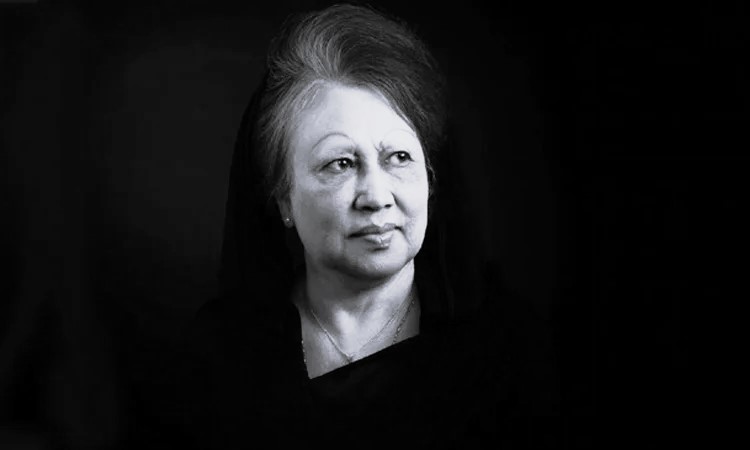
Dhaka – Begum Khaleda Zia, the former prime minister of Bangladesh and Chairperson of the Bangladesh Nationalist Party (BNP), passed away on Tuesday at Evercare Hospital in Dhaka. She was 80 years old.
Zia had been undergoing treatment at the hospital for more than a month. Known to her supporters as an uncompromising figure in Bangladeshi politics, her death was announced by BNP Secretary General Mirza Fakhrul Islam Alamgir.
“Our beloved leader, Begum Khaleda Zia, passed away around 6 am, just after Fajr prayers,” Alamgir told a press briefing outside the hospital.
The three-time former prime minister had been suffering from multiple health complications, including cardiac, pulmonary, liver, and kidney issues, as well as diabetes, arthritis, and eye ailments. She had a permanent pacemaker and had previously undergone a heart stent procedure.
She was admitted to Evercare Hospital on November 23 on the advice of her medical board after being diagnosed with infections in her heart and lungs. She was also suffering from pneumonia.
Since returning from London on May 6, where she had received advanced medical care, Khaleda Zia had been undergoing regular check-ups at Evercare Hospital.
Political leaders from home and abroad have condoled her passing. Among them are Muhammad Yunus, Chief of Bangladesh’s interim administration; Indian Prime Minister Narendra Modi, and Pakistani Prime Minister Shahbaz Sharif.
Khaleda Zia leaves a strong political legacy, having become Bangladesh’s first female prime minister in 1991, a milestone in the country’s democratic journey. She assumed office following a national election and introduced the parliamentary form of government. She also established the constitutional provision for a caretaker government to oversee national elections and ensure their fairness.
Although Khaleda Zia had been imprisoned since 2018, her party and family members repeatedly urged the government to allow her to go abroad for better treatment. These requests were declined by the then Awami League-led administration.
She is survived by her son, Tarique Rahman, and a host of relatives and admirers. Tarique Rahman returned home on December 25 after 17 years in exile in London. Khaleda Zia’s younger son, Arafat Rahman Koko, died several years ago in Malaysia.
Born in Dinajpur in 1945, Khaleda Zia initially attended Dinajpur Missionary School and completed her matriculation from Dinajpur Girls’ School in 1960. Her father, Iskandar Mazumder, was a businessman, and her mother, Tayeba Mazumder, was a homemaker. Nicknamed “Putul,” she was the second of five siblings.
In 1960, she married Ziaur Rahman, then a captain in the Pakistan Army, and continued her education at Surendranath College in Dinajpur until 1965. When the Liberation War began in 1971, Ziaur Rahman revolted and participated in the conflict.
Following the assassination of President Ziaur Rahman on May 30, 1981, the BNP faced a leadership crisis. At this critical juncture, Khaleda Zia, who had never been involved in politics, joined the party. She became its vice-president on January 12, 1984, and was elected chairperson on May 10 of that year. She was re-elected to the position in January 2010.
Under her leadership, the BNP formed a seven-party alliance in 1983 and launched actions against the autocratic regime of Hussain Muhammad Ershad. Her movement was restricted, and she was detained several times by the Ershad government. Undaunted, she continued to lead the movement for his ouster, cementing her reputation as the “uncompromising leader.”
In the 1991 parliamentary election, the BNP emerged as the single majority party. Khaleda Zia contested five constituencies across three consecutive parliamentary elections and won all of them.
On March 20, 1991, she was sworn in as the first female prime minister of Bangladesh. She took the oath again on September 19, 1991, under the new parliamentary system she had introduced.