
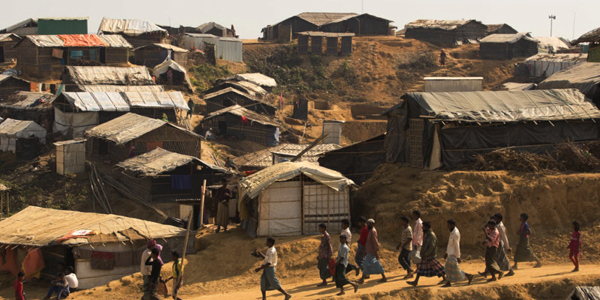
For almost one million Rohingya refugees, daily life in the overcrowded camps at Cox’s Bazar is not governed by protection but rather by deprivation. What started as an emergency in 2017 with the genocidal military campaign of Myanmar has transformed into one of the longest-lasting human rights and public health crises in the world. After eight years, the Rohingyas are still stateless, their movements restricted, they are denied education, and they are living in conditions that slowly and systematically take away their physical and mental health. Even if there has been a humanitarian presence for many years, the response is still based on short-term relief rather than the rights-based approach that is required under international law.
At present, over 960,000 Rohingya refugees currently residing in Bangladesh, and almost half of them are children. Cox’s Bazar, the south-eastern Bangladeshi district, is referred to as the largest and most densely populated refugee settlement since they are all crammed into only 8,000 acres of land. The health implications of this situation are very serious and have been thoroughly documented. According to research, 94 percent of Rohingya adults had gone through at least one traumatic event before entering Bangladesh, while 63 percent suffer from severe psychological distress with post-traumatic stress disorder, depression, and anxiety. Infectious diseases such as respiratory infections, diarrheal illness, scabies, measles, and diphtheria are constantly present in the camps; the situation is worsened by chronic malnutrition as a result of the regular reduction in food rations given to the refugees.
However, the crisis, in its overall scope, can be said to be beyond just a biomedical crisis; it is one of structural issues. Restrictions on language, curriculum, and school infrastructure account for the denial of formal education to over 400,000 Rohingya children. Barbed-wire fencing, along with the system of permits, limits the refugees to the camp perimeters, thereby affecting their access to livelihoods and external medical care. Natural disasters like fires, floods, and landslides are common; over 240 fires in the camp were reported only in 2023. Furthermore, the health facilities closed one-third of their services due to the 2024 Joint Response Plan being one-third funded.
A senior humanitarian practitioner in Cox’s Bazar recently commented that the service providers are now left with no other choice but to ‘triage dignity itself,’ where they will have to decide which basic services are to be provided and which ones will be terminated. These consequences should not be seen as unavoidable. They are solely the product of political power decisions, policy-making choices, and global indifference that has lasted for a long time.
When looked at from a human rights angle, the situation is crystal clear as regards the violations. The right to the highest possible standard of physical and mental health is guaranteed under the International Covenant on Economic, Social, and Cultural Rights. However, not only does refugees of Rohingya receive poor sanitation and very little nutrition allowance, but also they do not receive necessary medications, have no monitoring of diseases, and do not have access to mental health services, which are all basic needs.
The refusal of the right to education is a direct infringement on the rights enshrined in the Universal Declaration of Human Rights and the Convention on the Rights of the Child, which at the same time not only affect the learning process but also the future health, peace, and unity of the society. The protracted situation of encampment and restriction of movements raises serious issues under the International Covenant on Civil and Political Rights, especially when the restrictions are broad, open-ended, and disproportionate.
The crisis is attributed to various players. The main blame lies with Myanmar that committed ethnic cleansing to displace the Rohingya and still does not offer citizenship, security, and rights, thus turning return impossible. Bangladesh, on its part, has welcomed a big refugee population and at the same time set up policies that limit access to education, jobs, and movement, resulting in long-term violations of rights. International donors have ungrudgingly allowed the crisis to worsen, whose funding has sharply decreased by almost 75 percent since 2020. Multinational organizations, after years of working together, have not been able to reach durable political solutions or achieve significant refugee involvement in decision-making processes.
What is required at this point is not an escalation of the emergency rhetoric but rather a change of policy.
To begin with, the humanitarian response has to undergo a complete transformation and be based on a human rights health framework as proposed by the World Health Organization (WHO), the International Organization for Migration (IOM), and the UN human rights system. That would incorporate primary care and mental health services, powerful disease surveillance, reinforcing water and sanitation facilities, and involving refugees in the country-wide health planning.
Second, education and safe livelihoods should be accessible to more people. The social determinants of health causing poor health and dependency would be affected positively by the full implementation of the Myanmar Curriculum Framework, accredited secondary and digital education, and controlled work permits.
The international community, finally, must enter into a multilateral accountability compact to support safe, voluntary, and rights-based repatriation, which would incorporate international monitoring in Rakhine State, restoration of citizenship rights, and targeted consequences for obstruction.
The Rohingya crisis is not only a humanitarian disaster; it is also a measure of global moral leadership. The crisis of the humanitarian emergency can be alleviated through aid. The human rights issue, on the other hand, requires political bravery, continuous support, and structural reform. The Rohingya people are entitled to more than mere existence; they should be treated with respect, and the world has to act upon this demand at last.
(Shishir Kumar Shil, is a current student of the School of Global Public Health at New York University, USA. He can be reached by e-mail: sks9361@nyu.edu)
References:
Hossain, Z. Z., Arefin, A., & Hossain, A. (2022). Addressing child protection issues in Bangladesh’s Rohingya and host community to improve children’s health. The Lancet Regional Health – Southeast Asia, 5, 100070. https://doi.org/10.1016/j.lansea.2022.100070
Human Rights Watch. (2019, December 3). “Are we not human?” Denial of education to Rohingya refugee children in Bangladesh. https://www.hrw.org/report/2019/12/03/are-we-not-human/denial-education-rohingya-refugee-children-bangladesh
Riley, A., Akther, Y., Noor, M., et al. (2020). Systematic human rights violations, traumatic events, daily stressors and mental health of Rohingya refugees in Bangladesh. Conflict and Health, 14, 60. https://doi.org/10.1186/s13031-020-00306-9
Wali, N., Chen, W., Rawal, L. B., et al. (2018). Integrating human rights approaches into public health practices and policies to address health needs amongst Rohingya refugees in Bangladesh: A systematic review and meta-ethnographic analysis. Archives of Public Health, 76, 59. https://doi.org/10.1186/s13690-018-0305-1
Hossain, A. N. M. Z. (2023). Educational crisis of Rohingya refugee children in Bangladesh: Access, obstacles, and prospects to formal and non-formal education. Heliyon, 9(7), e18346. https://doi.org/10.1016/j.heliyon.2023.e18346
International Rescue Committee. (n.d.). Rohingya crisis: What to know and how to help. https://www.rescue.org/article/rohingya-crisis-what-know-and-how-help
Harvard Humanitarian Initiative. (2025, September). Humanitarian crisis of Rohingya refugees in Bangladesh: Issues in their living conditions and host communities. https://hhi.harvard.edu/news/2025/09/humanitarian-crisis-rohingya-refugees-bangladesh-issues-their-living-and-host
Médecins Sans Frontières. (n.d.). Rohingya refugee crisis. https://www.doctorswithoutborders.org/what-we-do/focus/rohingya-refugee-crisis
Norwegian Refugee Council. (2025). Eight things you should know about the Rohingya crisis in Bangladesh. https://www.nrc.no/feature/2025/eight-things-you-should-know-about-the-rohingya-crisis-in-bangladesh