


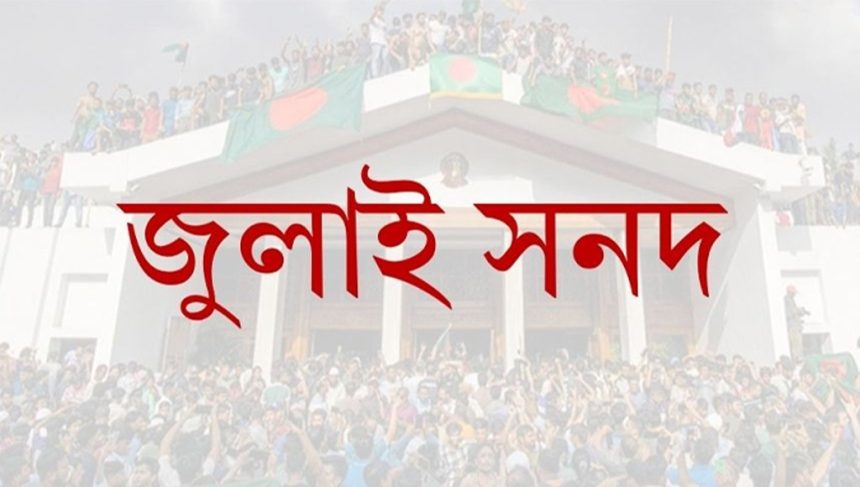
Political parties are set to sign a landmark document on Friday, affirming their commitment to a comprehensive state reform agenda for a post-Hasina Bangladesh and legitimizing the mass uprising that brought about the political changeover last year.
The uprising ousted former prime minister Sheikh Hasina, who now faces multiple criminal charges for her actions during her 15-year rule. The changeover has paved the way for sweeping changes to all three branches of the state: the legislature, executive, and judiciary.
An interim administration, led by Nobel laureate Muhammad Yunus, was installed three days after Hasina fled to neighboring India amid violent protests on August 5, 2024. This administration proposed the state reforms through a National Consensus Commission, which it formed.
Headed by Yunus, the commission prepared draft proposals and opened them for discussion with political parties, particularly those opposed to Hasina’s Awami League and its allies, who had ruled the country for the preceding 15 years.
Over eight months, the commission held a series of meetings divided into three phases. Participants debated the proposals clause by clause, registering their opinions, observations, and reservations. This process culminated in a final document, styled the “July National Charter 2025,” which parties will now sign to pledge implementation of the agreed-upon reforms.
The signing ceremony will be witnessed by interim head Yunus and held at the South Plaza of the Jatiya Sangsad Bhaban (National Parliament building) in Dhaka. The Vice-Chairman of the National Consensus Commission, Ali Riaz, other commission members, and two representatives from each political party are expected to sign the charter.
Riaz said the parties can be able to sign the document even after Friday.
The Reform Process
The interim administration’s first major initiative was to form six thematic reform commissions (Constitution, Electoral System, Public Administration, Anti-Corruption Commission, Police, and Judiciary). The National Consensus Commission then held discussions with political parties on these commissions’ proposals.
In the first phase, the commission met with 33 parties, followed by 30 in the second phase. From February to July, consensus was reached on 84 reform proposals, according to the commission.
A draft of the July National Charter was sent to parties on August 16. A revised draft was later circulated correcting correct errors, and the deadline for feedback was extended to August 22. Following further discussions with parties and experts, the commission finalized the charter and delivered the 40-page document to all parties on Tuesday, October 14.
Historical Context in the Charter
The document outlines Bangladesh’s political history, from the British colonial era through key turning points like the 1952 Language Movement, the 1966 autonomy movement, the 1969 mass uprising, and the 1971 Liberation War.
It also details the post-independence political landscape, including the introduction of the one-party BAKSAL system in 1975 and the return to multi-party democracy in 1978.
The charter states that the democratic aspirations born from the Liberation War, embodying the principles of equality, human dignity, and social justice, have not been fully realized after 53 years. It notes that democratic practices have “repeatedly stumbled,” citing the collapse of BAKSAL after a military coup and the fragility of subsequent democratic systems.
The document is sharply critical of the recent past, accusing the Awami League government, which came to power in 2009, of gradually discarding democratic values and assuming an “undemocratic and fascist character.” It alleges the government established a “reign of chaotic and horrific terror” through enforced disappearances, extrajudicial killings, and the persecution of critics.
It further accuses the government of destroying the electoral system by holding “three consecutive controversial and farcical elections” (2014, 2018, 2024) and of “institutionalizing partisan influence” to control state institutions and enable corruption.
The 2024 Uprising
The charter states that this backdrop fueled a 16-year democratic movement, culminating in an “unprecedented mass uprising” during the July-August 2024 one-point movement. It highlights the participation of students, laborers, women, professionals, and expatriate Bangladeshis, whose halting of remittances played a key role.
It notes that at the “final moment,” serving and retired armed forces members accelerated the fall of the government. The document claims that over a thousand unarmed citizens were killed and more than twenty thousand seriously injured in the struggle, leading to Sheikh Hasina and her allies being “forced to flee.”
In conclusion, the charter states that this uprising revealed a powerful public demand for comprehensive state reform. This led the new government to establish the six reform commissions.
The document ends with a seven-point commitment, urging political party representatives to sign the charter and uphold the will of the people expressed in the July 2024 uprising, grounded in democratic principles and national consensus.