

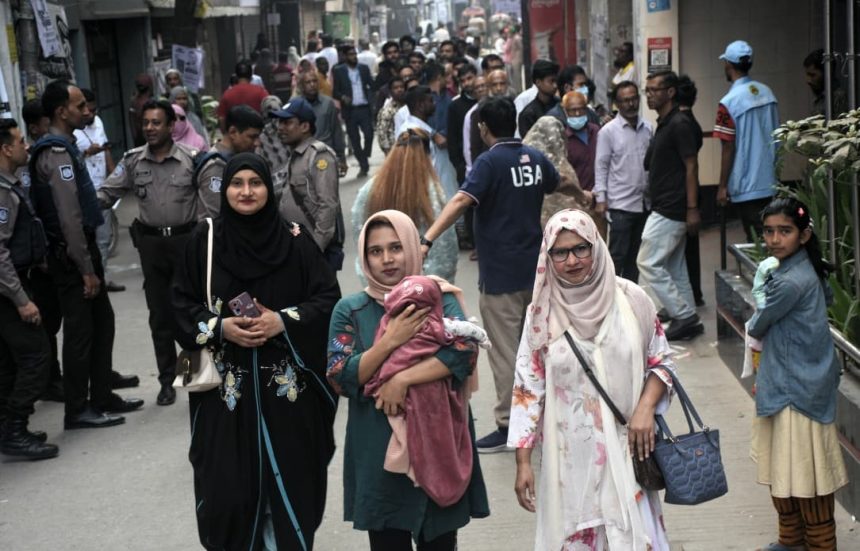
Dhaka – Polling stations opened across Bangladesh on Thursday in the country’s first election since a violent uprising ousted former prime minister Sheikh Hasina in 2024.
Television footage showed long queues of voters forming from daybreak, as voting began at 7:30 a.m. and will continue without a break until 4:30 p.m. at nearly 43,000 polling stations.
The 13th parliamentary election is being held alongside a referendum on constitutional reforms stemming out of the uprising.
Tight security measures have been put in place to maintain order during and after the vote. Elections are being held in 299 out of 300 parliamentary constituencies, after authorities canceled polling in the Sherpur-3 seat following the death of a candidate.
In a brief televised address to the nation on Wednesday, Chief Election Commissioner AMM Nasir Uddin called on all concerned to extend full cooperation and maintain a spirit of harmony to ensure a free, fair, and peaceful election.
“Differences of opinion are natural in a democracy. With this in mind, come to the polling stations in a festive spirit and vote for your preferred candidate,” he said.
He urged everyone to accept the results as part of the democratic process.
An interim administration, led by Nobel Peace Prize laureate Muhammad Yunus and installed shortly after the uprising, is overseeing the elections. Yunus is scheduled to cast his vote at the Gulshan Model School and College polling station in the capital, Dhaka, his office said in a statement.
“All-out preparation and extensive security measures have been taken across the country to stage the polls in a free, fair and peaceful manner,” said Election Commissioner Abdur Rahmanel Masud.
He said nearly 900,000 law enforcement personnel had been deployed to enforce security, prevent violence, and maintain order during and after the voting. A total of 2,098 executive magistrates and 657 judicial magistrates have also been appointed to perform election duties, serving a five-day term that began Tuesday.
The election pits the Bangladesh Nationalist Party (BNP) against Jamaat-e-Islami as the main contenders. The vote is expected to mark the end of the 18-month rule of the interim administration installed after the 2024 uprising.
Hasina’s Awami League party was excluded from the election race as the interim administration slapped a ban on the activities of the party in May last year under an executive order. Hasina herself is disqualified after a court in Dhaka convicted and sentenced her to death in a case related to brutal suppression of the 2024 unrest that left according to UN estimated 1,400 people.
Masud said he expects turnout to be high in the coming hours, noting that many citizens have not had the opportunity to vote in a long time. He also anticipated a large number of young and first-time voters.
According to Election Commission (EC) statistics, voting is being held at 42,779 polling centers across the country, with a total of 247,482 polling rooms. The commission has enrolled 12,77,11,893 voters across 299 constituencies.
EC Senior Secretary Akhtar Ahmed earlier said at a briefing that 50 political parties are contesting the election, fielding a total of 2,028 candidates. Of these, 273 are independents, while the BNP has put forward the highest number—291 candidates.
He said 63 parties, including the BNP, had fielded 63 female candidates, with another 20 women contesting independently.
According to the EC, some 800,000 officials—excluding those involved in security and law enforcement—are on election duty. This includes 69 returning officers, 598 assistant returning officers, 42,779 presiding officers, 247,482 assistant presiding officers, and 4,95,964 polling officers.
In addition, about 15,000 officials are handling postal voting.
Election Commissioner retired brigadier general Abul Fazal Md Sanaullah said that apart from the deployment of over 958,000 Ansar, police, army, and RAB personnel, the commission is using—for the first time—unmanned aerial vehicles (UAVs), drones, and body-worn cameras for security personnel to enhance surveillance.
EC officials earlier said the security deployment includes 103,000 army troops, 8,500 navy and air force personnel, 37,453 paramilitary BGB soldiers, and 3,585 paramilitary Coast Guard members.
The number of police officers on polling duty is 187,603, with 9,349 RAB personnel. The largest contingent comes from the Ansar, with 567,868 members deployed. A total of 1,922 Bangladesh National Cadet Corps (BNCC) members are also assisting in maintaining order.
A total of 55,454 observers from 81 local organizations are monitoring the elections, alongside 394 foreign poll monitors.
Nearly 200 foreign journalists have arrived in Bangladesh to cover the elections and the referendum.
Of the international observers, 80 represent various international organizations, and 239 come from different countries, including independent European observers.
Major international organizations that have sent observer missions include the Asian Network for Free Elections (ANFREL), the Commonwealth Secretariat, the U.S.-based International Republican Institute (IRI), and the National Democratic Institute (NDI).
Other organizations include the Organization of Islamic Cooperation (OIC), the International Conference of Asian Political Parties (ICAPP), and the European External Action Service.
Observers have arrived from 21 countries, including Pakistan (8), Bhutan (2), Sri Lanka (11), Nepal (1), Indonesia (3), the Philippines (2), Malaysia (6), Jordan (2), Turkey (13), Iran (3), Georgia (2), Russia (2), China (3), Japan (4), South Korea (2), Kyrgyzstan (2), Uzbekistan (2), South Africa (2), and Nigeria (4).
Fifty-one observers representing organizations such as Voice for Justice, Democracy International, SNAS Africa, the SAARC Human Rights Foundation, and the Polish Institute of International Affairs are monitoring the election in their individual capacities, according to information from the Ministry of Foreign Affairs and the Election Commission.